

Leave Your Message
-
Phone
-
E-mail
-
Whatsapp
-
WeChat

Choosing the right Commercial Ro Water System is rarely a simple price comparison. Global buyers must examine water quality, production volume, energy use, maintenance access, and local installation conditions. A system that performs well in a coastal factory may struggle in a remote inland plant. Small details matter.
This guide reviews ten commercial RO systems for hotels, food processors, hospitals, manufacturers, and water suppliers. Each option is considered through practical factors, including membrane performance, pretreatment design, recovery rate, automation, safety controls, and replacement-part availability. Technical specifications come from manufacturer information, field experience, and established water-treatment principles. Still, published figures may change with feedwater temperature and pressure.
Real performance varies.
A reliable Commercial Ro Water System should match the source water, not merely promise high output. Buyers should request laboratory test results, operating manuals, warranty terms, and service records before committing. Pay attention to sediment filters, carbon vessels, antiscalant dosing, and the cleaning-in-place process. These components often determine whether the membranes last for years or fail early.
This comparison also recognizes practical weaknesses. Some systems offer advanced controls but require skilled technicians. Others are easier to maintain but consume more water during operation. There is no perfect choice. The best solution depends on verified water analysis, daily demand, installation space, budget, and long-term support. Buyers should use this overview as a careful starting point, then confirm every critical detail with qualified suppliers and independent testing.
Commercial RO Water System Types and Core Treatment Principles
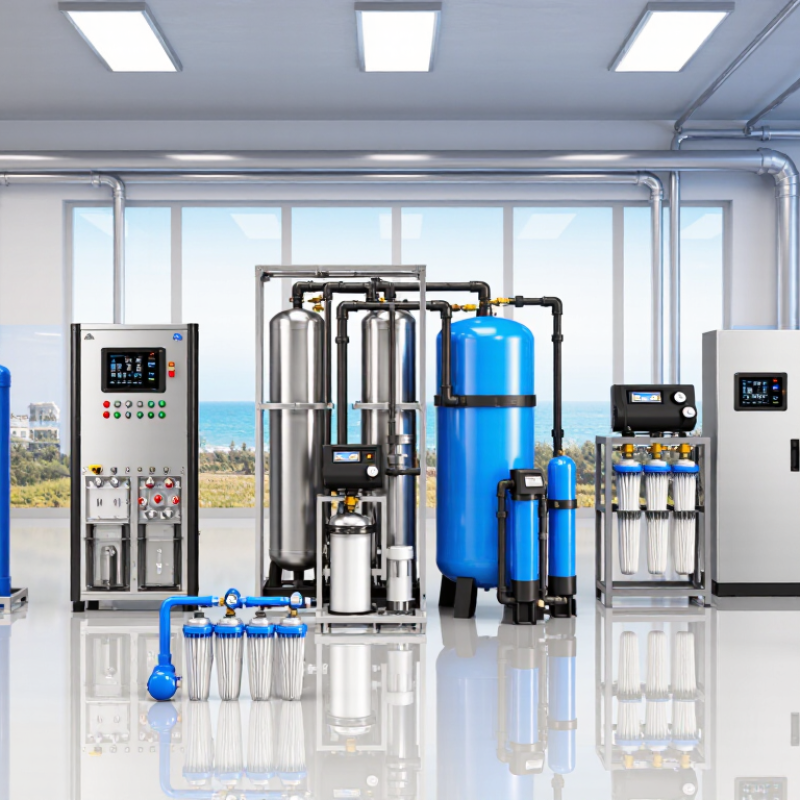
Commercial reverse osmosis systems differ mainly by feedwater quality, capacity, and recovery targets. Brackish-water RO handles dissolved salts from wells and inland sources. Seawater RO requires higher pressure and stronger corrosion control. Municipal-water systems usually need less desalination, but chlorine removal remains essential because chlorine can damage polyamide membranes. Single-pass units suit general process water, while two-pass systems support stricter conductivity limits.
The treatment principle is selective separation. Feedwater passes through pretreatment, cartridge filtration, high-pressure pumps, and semi-permeable membranes. Water molecules move through the membrane, while salts, microorganisms, and many dissolved contaminants remain in the concentrate stream. Recovery often ranges from 50% to 85%, depending on scaling risk and feedwater chemistry. A 2024 UNESCO water report notes that agriculture uses about 70% of global freshwater withdrawals, increasing pressure on industrial water efficiency. Still, chasing maximum recovery can create costly scaling problems.
Operational details matter. Pretreatment should control turbidity, hardness, iron, and biological growth before membrane loading. Conductivity meters, pressure gauges, and flow sensors reveal gradual performance loss. The World Health Organization reported that 2.2 billion people lacked safely managed drinking water in 2022, showing why reliable treatment design matters. Yet a perfect specification rarely exists. Seasonal temperature changes, poor sampling, and underestimated cleaning needs can weaken an otherwise sound system. Field experience suggests leaving practical operating margins, not designing only for ideal laboratory conditions.
Comparison of widely used commercial reverse osmosis system configurations. Figures are typical design ranges and must be confirmed through feed-water analysis, local regulations, and a project-specific engineering review.
| Rank | Commercial RO System Type | Typical Commercial Application | Typical Permeate Capacity | Typical Recovery | Typical Operating Pressure | Typical Dissolved-Solids Reduction | Common Pretreatment | Core Treatment Principle |
|---|---|---|---|---|---|---|---|---|
| 1 | Compact Light-Commercial RO System | Small restaurants, offices, cafés, clinics, and retail outlets | 0.25–2.0 m³/day | 25–50% | 8–15 bar | 95–99% | Sediment filter, carbon filter, optional antiscalant dosing | A high-pressure pump forces pretreated water through a semi-permeable membrane. Water passes through as permeate while most dissolved salts, particles, and microorganisms are rejected into the concentrate stream. |
| 2 | Restaurant and Foodservice RO System | Restaurants, bakeries, cafés, beverage dispensers, and ice machines | 1–5 m³/day | 30–60% | 8–16 bar | 95–99% | Sediment filtration, activated carbon, hardness control, scale protection | RO reduces hardness and dissolved solids that can affect taste, food preparation, steam equipment, and ice production. A final carbon or polishing stage may be added where taste control is required. |
| 3 | Hotel and Hospitality RO System | Hotels, resorts, staff facilities, kitchens, and guest drinking-water systems | 5–30 m³/day | 40–70% | 10–18 bar | 95–99% | Multimedia filter, carbon filter, cartridge filter, softener or antiscalant | A centralized membrane train produces consistent low-TDS water for multiple points of use. Storage tanks and distribution pumps help balance variable demand throughout the day. |
| 4 | Commercial Bottled-Water RO System | Water bottling, refill stations, and packaged drinking-water preparation | 10–100 m³/day | 45–75% | 10–20 bar | 95–99% | Multimedia filtration, activated carbon, cartridge filtration, antiscalant or softening | RO removes a broad range of dissolved contaminants and provides a stable feed for polishing. UV disinfection, ozone, and final filtration may be used as separate downstream barriers according to the water-safety plan. |
| 5 | Industrial Process-Water RO System | Manufacturing, metal finishing, chemical processing, and general process water | 20–500 m³/day | 50–85% | 12–25 bar | 95–99% | Coagulation or clarification when needed, multimedia filter, carbon, cartridge filter, antiscalant | The membrane separates water from dissolved ions and many low-molecular-weight contaminants. Multiple membrane stages, concentrate recycling, or energy-recovery measures can improve water utilization. |
| 6 | Boiler-Feed RO System | Boiler houses, laundries, hospitals, hotels, and industrial steam generation | 10–300 m³/day | 60–85% | 10–25 bar | 95–99% | Softener or antiscalant, multimedia filtration, carbon filtration, cartridge filtration | RO lowers hardness, silica, chloride, and other dissolved loads to reduce boiler blowdown and scaling risk. A downstream deionization or electrodeionization stage may be required for high-pressure boilers. |
| 7 | High-Recovery Brackish-Water RO System | Municipal supply, well water, commercial buildings, and inland water reuse | 25–1,000 m³/day | 65–90% | 12–30 bar | 95–99% | Clarification, multimedia filtration, cartridge filtration, antiscalant, pH control where required | Higher recovery concentrates salts in the reject stream, so scaling potential must be controlled through water analysis, dosing, staged arrays, concentrate management, and careful flux selection. |
| 8 | Seawater RO System | Coastal hotels, ports, islands, ships, and municipal desalination | 50–5,000+ m³/day | 30–50% | 55–80 bar | 98–99.7% | Intake screening, dissolved-air flotation or clarification when needed, multimedia or ultrafiltration, cartridge filtration | High-pressure seawater RO overcomes the high osmotic pressure of saline feed water. Energy-recovery devices can transfer hydraulic energy from the concentrate stream back to the feed system. |
| 9 | Wastewater-Reuse RO System | Cooling towers, industrial reuse, municipal reuse, and tertiary water recovery | 50–10,000+ m³/day | 60–85% | 10–30 bar | 90–99% | Biological treatment, clarification, ultrafiltration or microfiltration, cartridge filtration, antiscalant | RO acts as a polishing barrier after biological and suspended-solids removal. Effective pretreatment is essential to reduce fouling from organic matter, colloids, microorganisms, and residual disinfectant. |
| 10 | Two-Pass RO and RO-Polishing System | Pharmaceutical support utilities, laboratories, electronics, and high-purity manufacturing | 5–500 m³/day | 60–85% overall | 10–30 bar per RO pass | Up to 99% per pass, depending on feed chemistry | Multimedia filtration, carbon or dechlorination, cartridge filtration, first-pass RO, optional degassing | The second RO pass treats the first-pass permeate to reduce remaining ionic contaminants and improve quality stability. Electrodeionization, mixed-bed deionization, UV, or ultrafiltration may follow when specific purity targets apply. |
Technical note: Actual capacity, recovery, pressure, salt rejection, and pretreatment requirements vary with temperature, feed-water salinity, hardness, silica, iron, manganese, organic content, microbial load, membrane selection, and required permeate quality. RO permeate is not automatically sterile and should be paired with an appropriate disinfection and monitoring program where potable or hygienic water is required.