

Leave Your Message
-
Phone
-
E-mail
-
Whatsapp
-
WeChat

Choosing the best Complete RO Machine from China requires more than comparing prices, flow rates, or polished factory photographs. A reliable system should produce consistent water quality under real operating conditions. It should also include suitable pretreatment, quality membranes, stable high-pressure pumps, clear controls, and accessible technical support.
Dr. Menachem Elimelech, a leading membrane-treatment researcher, has emphasized, “The challenge is to develop membranes that can achieve high permeability and high selectivity simultaneously.” This principle remains important when evaluating a Chinese Complete RO Machine. A compact skid may look efficient, but poor pretreatment can quickly foul its membranes. Sediment filters, activated carbon, antiscalant dosing, and dependable instrumentation deserve careful inspection.
Look closely at the details.
A strong supplier should explain the machine’s recovery rate, feed-water limits, membrane brand, electrical configuration, and cleaning procedure. Stainless-steel pipework, neatly labeled valves, protected wiring, and an accessible control cabinet often reveal manufacturing discipline. Factory testing records and water-analysis reports add practical confidence. Independent verification is even better.
However, no single model is perfect for every application. A machine designed for municipal water may struggle with high salinity or unstable well water. Some suppliers also advertise impressive capacity without explaining seasonal feed-water changes. That is where buyers must remain critical.
This guide examines Chinese manufacturers through performance, component quality, customization, operating cost, documentation, and after-sales service. The goal is not to promote the cheapest option. It is to identify a Complete RO Machine that performs reliably, can be maintained locally, and matches the actual water source. Small omissions can become expensive lessons.
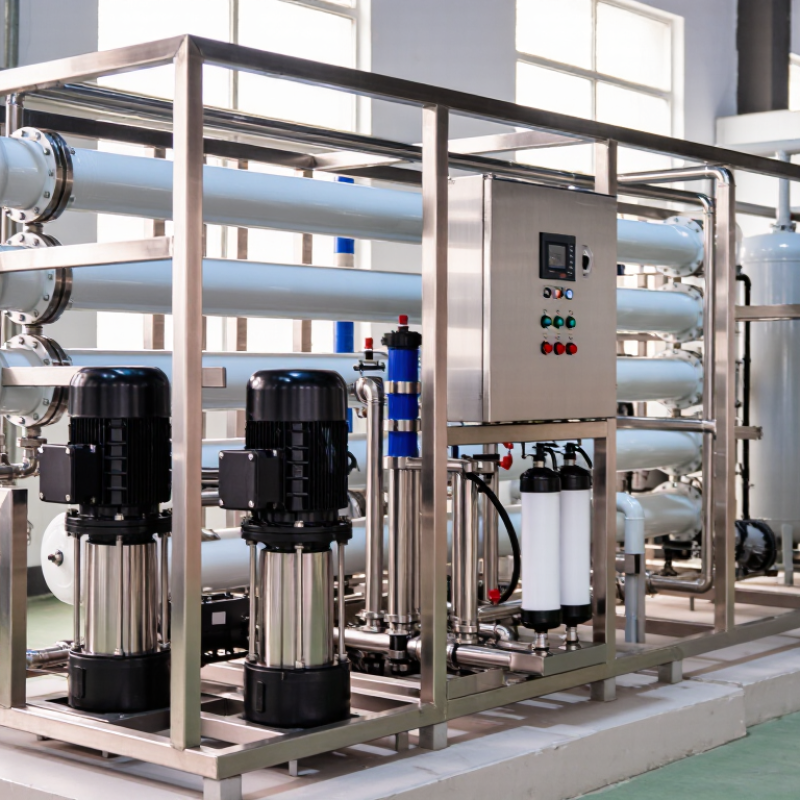
A complete reverse osmosis machine is more than a membrane inside a metal cabinet. It is an integrated water treatment system designed to reduce dissolved salts, metals, and many unwanted contaminants. A typical unit includes a feed pump, sediment filter, activated carbon filter, high-pressure pump, RO membrane housing, control panel, pressure gauges, flow meters, and storage connections.
The pretreatment stage protects the membrane from sand, chlorine, and organic particles. Then, the high-pressure pump pushes water through the semi-permeable membrane. Clean water passes through, while concentrated wastewater leaves through a separate outlet. A post-treatment filter may improve taste before the purified water enters a tank or distribution line. Small details matter here. Poor tubing, unstable pressure, or incorrect flow control can reduce performance.
Choosing the best complete RO machine from China requires more than comparing price and output claims. Check the feed-water analysis, daily capacity, recovery rate, membrane specifications, electrical standards, and replacement-filter availability. Ask for clear manuals, factory test records, material information, and realistic maintenance intervals. Stainless steel frames may suit demanding environments, while compact systems can work better in limited spaces. A common mistake is selecting capacity without considering seasonal water changes. That decision often creates unnecessary maintenance later. Reliable suppliers should explain limitations openly, not promise perfect purification for every water source.
The best complete RO machine depends on the required purified-water capacity, feed-water quality, recovery rate, operating pressure, and application. The table below compares typical complete RO system configurations without using company or brand information.
| Evaluation Dimension | Compact RO System | Commercial RO System | Industrial RO System | High-Recovery Industrial RO System |
|---|---|---|---|---|
| Typical Product-Water Capacity | 0.10–0.30 m³/h | 0.50–2.00 m³/h | 5–25 m³/h | 25–100 m³/h |
| Typical Applications | Homes, small offices, laboratories, drinking-water points | Restaurants, hotels, schools, clinics, small factories | Manufacturing, food processing, boiler feed, process water | Large factories, municipal supply, high-volume process-water production |
| Complete System Components | Feed pump, sediment filter, carbon filter, cartridge filter, high-pressure pump, membrane housing, RO membrane, control panel, pressure gauge and flow meter | Raw-water tank connection, multimedia or cartridge pretreatment, carbon filtration, dosing option, high-pressure pump, membrane vessels, RO membranes, control panel and product-water flow monitoring | Pretreatment train, chemical dosing, cartridge filtration, high-pressure pump, multiple membrane vessels, conductivity monitoring, automatic valves, PLC control and flushing circuit | Full pretreatment, antiscalant or pH dosing, multi-stage membrane array, energy-efficient high-pressure equipment, concentrate recirculation, CIP connections, PLC control and online water-quality monitoring |
| Typical Number of RO Stages | 1 membrane stage | 1 membrane stage | 1 or 2 membrane stages | 2 stages or staged high-recovery design |
| Typical Recovery Rate | 20–35% | 45–65% | 60–75% | 75–90%, depending on feed-water chemistry and scaling control |
| Typical Salt Rejection | Approximately 95–99% | Approximately 97–99.5% | Approximately 97–99.7% | Approximately 97–99.7%; actual performance depends on membrane selection and feed quality |
| Recommended Feed-Water TDS | Generally below 1,000 mg/L | Generally below 1,500 mg/L | Approximately 500–3,000 mg/L with suitable pretreatment | Up to approximately 5,000 mg/L in properly engineered systems |
| Typical Operating Pressure | 8–15 bar | 10–16 bar | 12–20 bar | 15–30 bar, depending on salinity and recovery target |
| Typical Pretreatment Requirements | Sediment and activated-carbon filtration; chlorine must be removed before the membrane | Sediment removal, carbon filtration, hardness control and cartridge filtration | Multimedia filtration, carbon filtration, softening or antiscalant dosing, cartridge filtration and dechlorination | Engineered pretreatment based on turbidity, hardness, silica, iron, manganese, chlorine and saturation-index analysis |
| Typical Product-Water Conductivity | Often 10–100 µS/cm, depending on feed water | Often 5–80 µS/cm, depending on feed water and membrane condition | Often 2–50 µS/cm; a second-pass RO or deionization system may be required for higher purity | Usually 1–30 µS/cm after optimized membrane treatment; polishing may be needed for ultrapure applications |
| Automation Level | Automatic start/stop, low-pressure protection and tank-level control | Automatic flushing, high- and low-pressure protection, tank-level control and conductivity alarm | PLC-based control, automatic valve operation, alarms, conductivity monitoring and data display | Advanced PLC control, remote monitoring option, flow balancing, staged operation, CIP management and water-quality alarms |
| Energy Consumption | Approximately 0.5–1.5 kWh per m³ of product water | Approximately 1–2.5 kWh per m³ | Approximately 1.5–3.5 kWh per m³ | Approximately 1.5–4 kWh per m³; energy recovery may reduce consumption in high-pressure applications |
| Best Choice When | Space, simplicity and low initial cost are more important than water recovery | A reliable balance of capacity, automation, operating cost and maintenance is required | Continuous industrial operation and stable product-water quality are required | Water conservation, high production capacity and reduced concentrate discharge are key priorities |
| Important Selection Checks | Verify feed pressure, membrane replacement availability, tank size and actual daily demand | Request a feed-water analysis and confirm pretreatment, recovery, electrical supply and spare parts | Confirm a complete water analysis, membrane array, design flux, cleaning method, materials and commissioning support | Confirm scaling calculations, concentrate disposal, corrosion-resistant materials, energy recovery and automatic cleaning provisions |